


Most teams don’t lose time writing. They lose time in review: scattered comments, unclear owners, version confusion, and last-minute approval scrambles.
AI proofing helps you tighten drafts faster, but the real speed gain comes when AI support is paired with a clear workflow for review, feedback, and approvals. In this guide, we’ll break down what AI proofing is, where it helps (and where it doesn’t), and how teams use Hive’s Buzz Proofing to keep review cycles moving without losing control.
What is AI proofing?
AI proofing is using AI to improve a document before it goes out the door, typically by checking:
- Spelling and grammar
- Clarity and concision
- Tone and brand voice consistency
- Terminology consistency (product names, capitalization, style rules)
- Structure and readability
- Risk flags (vague claims, missing context, confusing phrasing)
AI proofing is especially useful for marketing, product marketing, customer communications, proposals, internal updates, and any content that needs multiple eyes before it ships.
What AI can (and cannot) do in document proofing
AI proofing is good at:
- Catching grammar and spelling issues quickly
- Tightening wordy sentences
- Rewriting for a target tone (friendly, direct, formal, etc.)
- Flagging inconsistent terminology
- Suggesting clearer structure and scannable formatting
- Highlighting ambiguity (“this/that/it” with unclear references)
AI proofing struggles with:
- True fact-checking unless you provide sources
- Nuanced legal or compliance judgment
- Brand nuance without examples and guardrails
- Accountability (who approves, when, and what changed)
That last point matters most. AI can improve a draft, but it won’t fix a broken review process. That’s why teams pair AI support with a workflow tool like Hive, where the review loop actually happens.
The AI proofing workflow teams need (and how Hive supports it)
If you want AI proofing to reduce cycle time, use it inside a repeatable workflow. Here’s a simple one that works across most teams:
- Prep the document
- Define the audience, goal, and what cannot change (legal language, pricing, commitments).
- Run an AI proofing pass
- Focus on clarity, tone, structure, and consistency.
- Resolve suggestions
- Accept/reject edits and keep a record of what changed.
- Collaborative review
- Gather feedback in one place, with clear owners and next steps.
- Approval + version clarity
- Make it obvious who signs off and what “approved” means.
- Reuse what worked
- Save checklists, templates, and standards so the next draft moves faster.
Hive helps teams manage this end-to-end by keeping work, files, feedback, and decisions connected, so review doesn’t sprawl across docs, email chains, and DMs.
What is Buzz Proofing (and why it matters for AI proofing)?
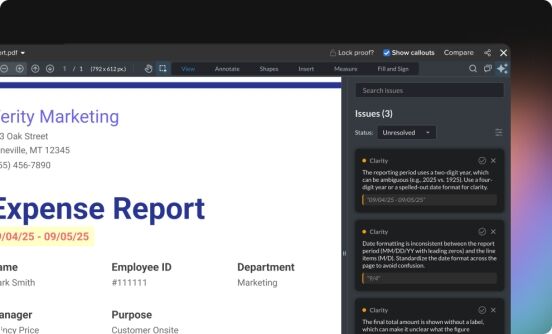
Buzz Proofing is Hive’s proofing experience built for teams who need to review content, consolidate feedback, and move to approval faster.
With Buzz Proofing in Hive, teams can:
- Centralize review feedback, so nothing gets lost
- Reduce back-and-forth by keeping discussion tied to the work
- Make ownership and next steps clearer during review and approval
If your “AI proofing” process breaks down after the draft is written, it’s usually a workflow issue, not a writing issue. Buzz Proofing is designed to solve that exact handoff from “draft” to “review” to “approved.”
Real examples: AI proofing before/after
Example 1:
Original:
“We’re excited to announce that we’ve been working on some improvements that will help your team collaborate more effectively and get more done with less effort.”
AI-proofed:
“We’ve launched improvements that help your team collaborate faster and keep work moving with less back-and-forth.”
Why it’s better:
- Removes filler (“we’re excited”, “some improvements”)
- Makes the benefit concrete (faster collaboration, less back-and-forth)
- Keeps meaning, fewer words
Example 2: Blog intro
Original:
“Proofreading is important for many teams because it helps ensure quality and consistency.”
AI-proofed:
“Most teams don’t lose time writing, they lose time in review. AI proofing helps tighten drafts fast, but the real win is pairing it with a clear approval workflow.”
Why it’s better:
- Replaces generic framing with a real pain point
- Sets up the workflow angle early (matches reader intent)
- More specific and compelling
Example 3: One-pager
Original:
“This helps teams manage documents better and reduces confusion.”
AI-proofed:
“This helps teams review content in one place, assign clear owners, and reduce version confusion during approval.”
Why it’s better:
- Replaces vague words (“better”, “confusion”) with workflow outcomes
- Clarifies the mechanism (one place, owners, approval)
AI proofing checklist (before anything goes out the door)
Use this checklist on customer-facing content (emails, landing pages, blogs, one-pagers):
- Is the purpose clear in the first few lines?
- Is there one clear CTA (not multiple competing CTAs)?
- Are claims specific, or do they sound vague/hand-wavy?
- Are product names and terms consistent?
- Does the tone match your brand voice?
- Are there risky absolutes (always, guaranteed, never)?
- Did you remove unclear “this/that/it” references?
- Is it clear who needs to approve, and by when?
What to look for in an AI proofing solution (for teams)
If you’re evaluating tools, don’t stop at “does it fix grammar?”
A strong AI proofing setup should include:
- High-quality suggestions (clarity, tone, structure)
- Collaboration (centralized feedback and discussion)
- Workflow and approvals (owners, due dates, visibility)
- Security and permissions
- Repeatability (templates, standards, checklists)
- Integration into where work already lives
Hive is built for exactly that: helping teams manage the work and the review cycle together, so you can move faster without sacrificing quality.
Ready to speed up review cycles?
If your team is stuck in long review loops and version confusion, AI proofing is a great start, but it works best inside a workflow built for collaboration and approvals.
Try Hive to keep documents, feedback, and approvals in one place, and move from draft to approved with less back-and-forth.


